There is one phrase I have heard time and again in over twenty years of working with children, young people and their families. It is uttered wearily, sometimes in despair, almost never with any ill intent: “He could do it, if only he wanted to.”

I understand this phrase. Behind it stands a mother who doesn’t know what to do next. A father who struggles for another hour at the kitchen table in the evening after work. A teacher who has to keep an eye on thirty children. The phrase is not a reproach directed at the child. It is a cry for help from the adults.
And yet it is almost always wrong.
Because in all these years, I have never met a single child who woke up one morning and decided: Today I want to fail. No child wants that. If a child isn’t learning, it’s not because they don’t want to — but because they simply can’t at the moment.
This article explains what lies behind this ‘inability’. It does so in two ways simultaneously: through three real-life stories that illustrate what learning blocks actually look like — and through scientific research that explains why they arise and how they can be resolved. By the end, you’ll see learning difficulties in a whole new light. And you’ll know where to start.
This is a comprehensive guide. It serves as the central overview of the topic of learning blocks — from here, in-depth links lead to all the individual topics.
What to expect in this guide
- The crucial difference: ‘doesn’t want to’ or ‘can’t at the moment’ — and why it determines every form of support
- Three real-life stories: Mia (exam anxiety), Tobias (giving up) and Jonas (family pressure) — each with a professional explanation
- An overview of the most common barriers to learning: from exam anxiety and concentration problems to perfectionism
- The way back: six steps instead of more pressure
- The professional background: the BrainHeart Learning and Resilience Model
- What parents and carers can do in practice
- Frequently asked questions and ways to explore the subject further
You do not need to read the guide from start to finish. Jump straight to what you need right now — and follow the links to the topics you’d like to explore in more depth.
The difference that changes everything: ‘won’t’ or ‘can’t’
Let’s start with the most important distinction of all. It may sound minor, but it determines the success of any form of support.
‘Doesn’t want to’ leads to pressure, consequences and reward systems — to everything one does to bend someone’s will. ‘Can’t at the moment’ leads to a completely different question: what is stopping the child? And this question opens a door that pressure always keeps shut.
Learning research over the last two decades is unequivocal on this point: learning is not purely an act of will. It is a physical, emotional and relationship-dependent process. Whether a child can take in, process and recall information depends not primarily on their effort, but on their inner state. And this state cannot be forced simply by wanting it.
Imagine an iceberg. Above the water’s surface lies what we see: the child who puts down their pen, who ‘goes blank’ during an exam, who plays the class clown rather than make a fool of themselves. That is the behaviour — and it is the behaviour we talk about, get annoyed by and want to change.
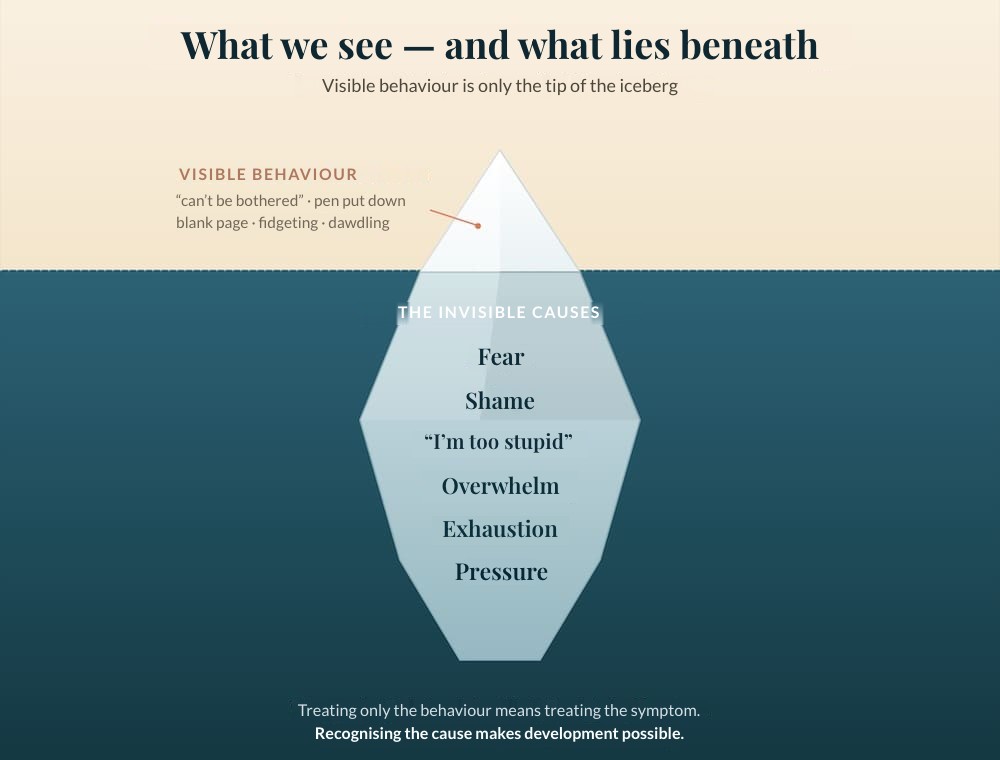
Beneath the surface, however, lies what nobody talks about because nobody sees it: the fear, the shame, the belief that ‘I’m too stupid’, the exhausted body that hasn’t had enough sleep for weeks. Visible behaviour is never the problem. It is a signal pointing to the problem.
Those who treat only the behaviour are treating the symptom. Those who read the signal find the cause. Let’s take a look at how this works in practice.
Mia, 10: When the body is quicker than the mind
Mia was ten when her mother brought her to see me. A bright, curious child. She could do her homework at home. When practising in the afternoon: no problem. She explained fractions to me as if she were the teacher.
And then, in the school test: nothing. A blank sheet of paper. ‘She’s lazy,’ someone had said. ‘She just doesn’t make the effort.’
But I watched Mia’s body as she told me about the exams. How her shoulders crept up. How her breathing became shallow. How her hands disappeared into her sleeves. This child wasn’t trying too little — she was trying so hard that, because of the sheer tension, she could no longer recall anything.
What happens in the body during this process
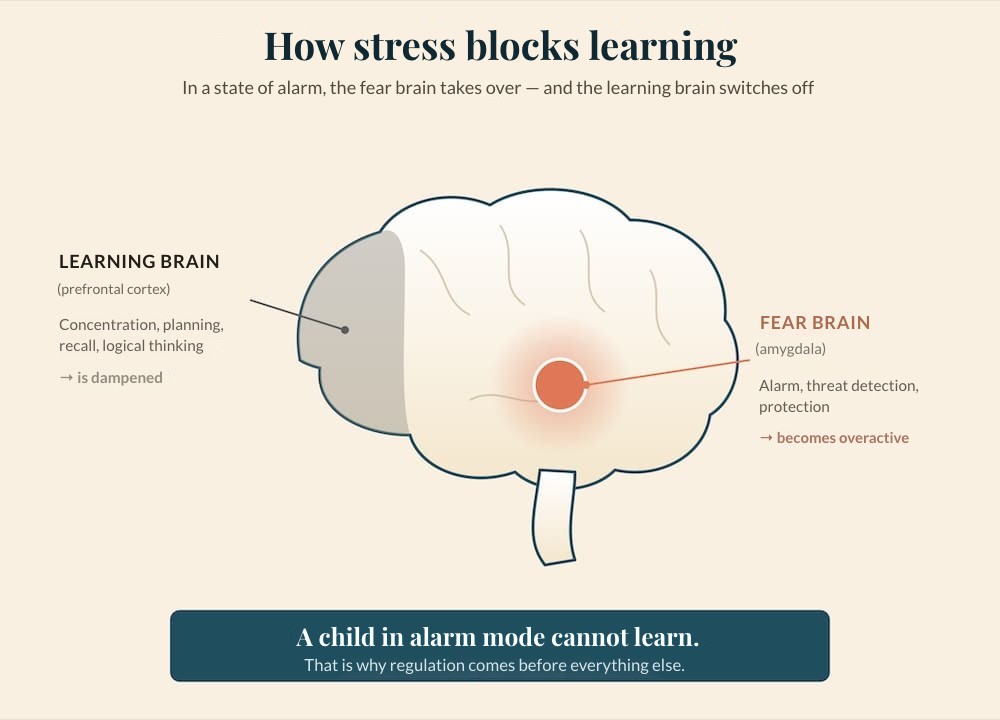
Mia’s story is a lesson about the nervous system. Under stress — and a dreaded exam is stress — the body switches into an ancient protective mode. The sympathetic nervous system takes over, stress hormones such as adrenaline and cortisol are released, and the body prepares for fight or flight.
This is disastrous for learning. Because in this state, activity in the prefrontal cortex decreases — precisely the region of the brain we need for concentration, recall and logical thinking. At the same time, the amygdala, our fear centre, becomes overactive. Put simply: the fear brain takes over, and the learning brain switches off. A child in this state cannot do maths — not because they have forgotten how to do it, but because their brain is currently occupied with something more important: perceived survival.
This explains the seemingly inexplicable thing about Mia: she knew the material at home but couldn’t recall it during the exam. It wasn’t that she lacked the knowledge; access to it was blocked under stress.
What helped
We didn’t do more fraction practice. Mia knew how to do fractions. We practised how to breathe again when fear sets in — a prolonged exhalation that signals to the nervous system: There is no danger here. You’re allowed to think. We brought the body out of its state of alarm before we turned to the mind.
Three months later, Mia sat her first maths exam without a mental blank. Not because she knew any more, but because, for the first time, she was able to demonstrate what she had known for a long time.
I often wonder how many Mias we call ‘lazy’ when in truth they are freezing from sheer effort.
Tobias, 14: When a child stops hoping
Tobias was fourteen and had a phrase he used as a shield: ‘It’s no use anyway.’ He’d say it whenever he was given a task, before he’d even looked at it. To the adults around him, it sounded like laziness, defiance or refusal.
But ‘It’s no use anyway’ is not defiance. It is a wound.
What lies behind it
Over the years, Tobias had experienced something that has a name in psychology: learned helplessness. The term was coined by the psychologist Martin Seligman and describes a specific pattern: when a living being repeatedly experiences that their actions have no effect on the outcome, they stop acting — even when a solution has long since been possible.
Tobias had tried his hardest and yet had failed. Time and time again. Until his nervous system drew the only logical conclusion: if trying doesn’t change anything anyway, then I’ll save myself the effort. That hurts less. What looked like indifference was, in truth, self-preservation. Tobias hadn’t stopped wanting — he’d stopped hoping.
The antidote to helplessness also has a name: self-efficacy. The psychologist Albert Bandura has shown that the belief ‘I can make a difference through my actions’ is the strongest source of motivation and perseverance. And — crucially — this belief does not arise from encouragement, praise or reward. It arises from one thing alone: genuine, first-hand experiences of success. Bandura calls these Mastery Experiences.
What helped
At first, I didn’t talk to Tobias about school. We looked for something he could do — anything at all. In the end, it was repairing an old bicycle. And when that bicycle rode again for the first time, I saw something in his face that I hadn’t seen for a long time: I’ve done it. Me.
That’s the spark. A single genuine ‘I’ve done it’ is worth more than a hundred ‘You’ll manage it’. Because one is experienced, the other merely spoken. Starting from that bicycle, we slowly worked our way back to school — not because Tobias suddenly loved maths, but because he believed once more that his actions could make a difference.
Incidentally, this illustrates why learning and emotional resilience are inseparable. Self-efficacy is not only the key to learning — it is also at the heart of resilience. A child who experiences themselves as effective will not give up at the next setback. In this way, every genuine learning experience also protects emotional strength, and all emotional strength protects learning.
Jonas, 8: When the problem isn’t with the child at all
The third story is the most uncomfortable one, because it draws us adults right into it.
Jonas was eight. When reading, he would falter, become restless and ‘couldn’t concentrate’. His parents were worried and did what loving parents do: they sat down with him in the evenings and practised. Every day. With growing tension, because things weren’t getting better – they were getting worse.
When I met Jonas — not at the kitchen table at home, but in a calm, pressure-free situation — he read with remarkable fluency. The problem wasn’t the reading. The problem was the situation in which the reading took place.
What lies behind it
Children do not regulate themselves on their own. They regulate themselves through the people around them. Research calls this co-regulation: a child’s nervous system orients itself to the nervous system of the adult beside them. If the adult is calm and attentive, the child calms down. If the adult is tense — even if purely out of concern — this tension is passed on.
Jonas’s parents hadn’t done anything wrong apart from what almost all parents do: they’d brought their own worries to the study table. And Jonas, highly sensitive to his parents’ mood, sensed the unspoken message every time he tried to read: This is important, and it’s making Mum and Dad anxious. Under this burden, his reading faltered — not because of a reading difficulty, but because of the emotional weight of the situation.
This is the systemic truth of learning: no child learns in isolation. They always learn within a field of relationships, expectations and unspoken messages. Sometimes the blockage lies not with the child, but within this field.
What helped
We didn’t work on Jonas’s reading. We worked on the reading situation. The parents learnt to recognise and manage their own tension before sitting down. The daily struggle with practice turned into a relaxed, shared reading time without any pressure to perform. Within a few weeks, what had appeared to be a persistent learning difficulty resolved itself.
I’m not telling Jonas’s story to make parents feel guilty — quite the opposite. The parents who come to me love their children. That is precisely why they suffer so much from the feeling that they can’t get through to them. But sometimes the most effective thing we can do for a child is to start with ourselves.
What all three stories have in common
At first glance, Mia, Tobias and Jonas all had the same problem: they ‘couldn’t learn’. And yet, in each case, the cause was completely different — a nervous system in a state of alarm, a lost belief in their own effectiveness, a tense web of relationships. Had all three been treated in the same way, with ‘more practice’ and ‘more discipline’, the actual problem would not have been touched in any of their cases.
This is the central insight of my work, and it can be summarised in a single sentence:
Learning does not begin with the subject matter. Learning begins with the child’s state of mind.
Before a child can learn, their nervous system must feel secure enough. Before they feel secure, they need a relationship in which they are not made to feel ashamed. And from this sense of security, this relationship and those first small successes grows the most valuable thing we can give a child: the conviction that ‘I can make a difference.’
An overview of the most common learning blocks
Mia, Tobias and Jonas represent three major patterns. In practice, we repeatedly encounter certain typical manifestations of learning blocks. Here is an overview — with links to the relevant in-depth articles.
Exam anxiety and mental blank
The child knows the material but loses it under exam pressure. One of the most common blocks and at the same time one of the easiest to resolve — because the knowledge is there and only access to it is blocked. More on this in Understanding exam anxiety and providing body-oriented support and Blackouts during exams: what happens in the brain.
Concentration problems
Often it is not attention deficit, but overstimulation, tiredness or inner restlessness. What looks like fidgeting is frequently an overloaded nervous system. Read more about this in Concentration in children: What really helps.
Learned helplessness
The “It’s no use anyway” attitude — as with Tobias. Children with a long history of failure give up before they even start. More on this in Learned Helplessness: When children give up before they start.
Perfectionism
Excessively high standards that paralyse: better not to start at all than to make a mistake. More on this in Perfectionism in children: when high standards paralyse learning.
Fear of school and reluctance to attend school
Avoidance as a signal — sometimes with systemic causes in school or the family. More on this in School Anxiety and Reluctance to Attend School: Identifying and Supporting the Causes.
Pressure in relationships
As with Jonas: sometimes the block lies not in the child, but in the tense learning situation. Read more in Why parents often unintentionally create pressure when it comes to learning.
However different these patterns may appear — they share a common root: they are not problems of willpower or intelligence, but problems of state, emotion or relationships. And that is precisely why they need a different solution from ‘practising more’.
The way back: six steps instead of more pressure
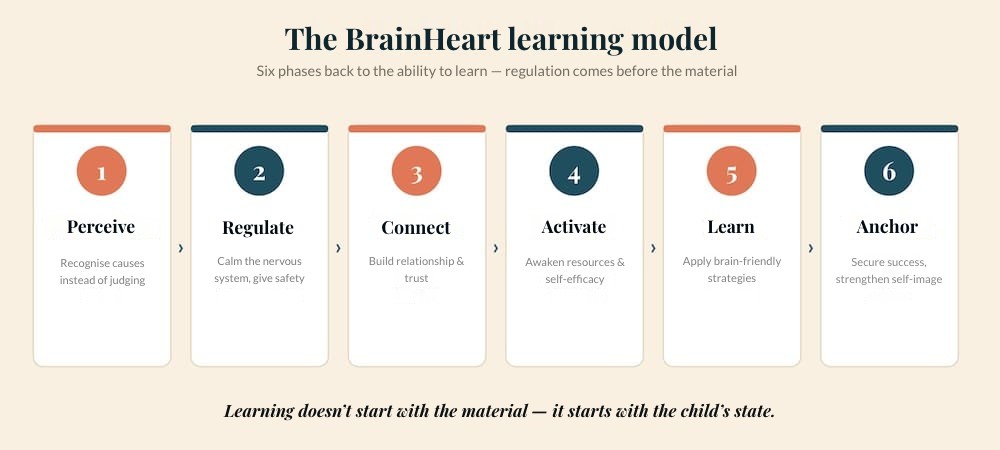
This insight has given rise to a model that describes the path back to the ability to learn in six steps. It is not a rigid sequence, but rather a roadmap — it shows where to start, depending on what a child needs at any given time.
- Perceive. First, understand what is really causing the block — rather than jumping to conclusions. For Mia, it was fear; for Tobias, hopelessness; for Jonas, the situation itself. Without this first step, any help starts in the wrong place.
- Regulate. Calm the nervous system, create safety. A child in a state of alarm cannot learn — so regulation comes before anything else.
- Connect. Build a stable, non-shaming relationship. It makes co-regulation possible; it is the bridge to the capacity to learn.
- Activate. Awaken resources, attention and self-efficacy — not through pressure, but through small, tangible successes.
- Learn. Only now do the actual learning strategies come into play — and they work because the foundations are solid.
- Anchor. Make the success visible and consolidate it into a new self-image: from ‘I can’t do that’ to ‘I can learn if I know how.’
The key point: most conventional approaches start at step five — with learning, the subject matter, the method. And they fail because the first four steps are missing. You cannot build a roof before the foundations are in place.
Each of the six phases is covered in detail in its own article: Perceive, Regulate, Connect, Activate, Learn and Anchor.
What parents and carers can do in practice
Even without formal training, much of this can be put into practice in everyday life. Not all at once — but every single step brings relief.
- Observe rather than judge. Swap the inner ‘You’re dawdling again’ for the question ‘What is my child missing right now that is keeping them from making progress?’ This question is not soft — it is precise.
- Listen to the body. Children are often unable to put into words what is blocking them. But their bodies show it: the queasy stomach before a class test, the clenched jaw, the sudden tiredness. These signals are information.
- Notice your own tension. Before you sit down for a learning session, briefly check your own state. A stressed adult cannot support calm learning — this is not a weakness, but biology.
- Make success something to experience. Look for situations in which your child genuinely experiences their own effectiveness — even if it’s outside school. Every ‘I did it’ rebuilds the foundation.
- Separate relationship from performance. Your affection must not depend on marks — and this must be felt, not just stated. A child who knows they are accepted unconditionally can take risks, make mistakes and learn again.
An invitation to take a closer look
I am writing all this as an invitation. An invitation to pause for a moment the next time a child ‘doesn’t want to learn’ and to ask a different question. Not: Why don’t they want to? But rather: What is stopping them right now?
This single altered question opens a door. It transforms struggle into curiosity. It transforms a ‘lazy child’ into a child who is showing us something. And it transforms us — from someone who wants to change a child into someone who wants to understand a child.
For the child who has given up is the one who persevered the longest. The child who appears indifferent is the one who has been hurt the deepest. The child who ‘doesn’t want to’ is the one who wanted it most desperately — until wanting began to hurt.
No child wakes up in the morning wanting to fail. Every child wants to be seen, wants to be able to do something, wants to belong. It is not our job to force them. Our job is to clear away the obstacles that stand between them and what they already are: curious, precious human beings who are capable of learning.
Sometimes it starts with a breathing exercise. Sometimes with a repaired bicycle. Sometimes with a parent leaving their worries at home. It always starts with someone taking a close look.
The theoretical background: The BrainHeart Learning and Resilience Model
The three stories illustrate what happens in practice. Behind them lies a systematic model that organises this practice and makes it usable for professional work: the BrainHeart Learning and Resilience Model. Anyone who works with children — as an educator, coach or therapist — will find here the theoretical framework behind the case stories.
An integrative model
The BrainHeart model is an integrative approach to supporting learning and development processes in children and young people aged between three and nineteen. It combines insights from neuropsychology, neurodidactics, the psychology of emotion, relationship theory, motivational psychology and systemic approaches into a process-oriented practice model.
It deliberately sets itself apart from three common approaches: from private tuition, which starts with schoolwork; from pure learning technique training, which teaches methods without taking the child’s state into account; and from motivational training, which attempts to steer behaviour through pressure or incentives. Instead, the BrainHeart model systematically starts with the child’s state — and understands learning as a physical, emotional, cognitive and systemic process.
Its fundamental premise is the statement that runs through all three stories: learning does not begin with the subject matter, but with the child’s state. Accordingly, the guiding methodological question is not ‘What learning technique does this child need?’, but ‘What does this child need for learning to become possible again at all?’
The six phases: a professional overview
1. Perceive. The initial diagnostic phase. Behaviour is read as a signal, not as a deficit. The coach systematically assesses whether there is a knowledge gap, a stress reaction, an emotional block, a damaged self-image or systemic pressure — often several factors interact. In terms of developmental psychology, this phase draws on research into time windows of brain development (Pauen) and the assessment of executive functions (Brunsting).
2. Regulate. The neurobiological basis. A child in a state of chronic stress cannot absorb, process or recall information — the stress-learning link via the HPA axis and its effect on the hippocampus and prefrontal cortex is well documented (McEwen, Sapolsky). Body-oriented regulation work (breathing, movement, body awareness) is based on the Defense Cascade model (Kozlowska et al.) and research into interoception. Mia’s story is an example of this phase.
3. Connect. The relational level. Through the calm, attentive presence of the facilitator, co-regulation becomes possible: the child’s nervous system regulates itself along with the adult’s stable nervous system. The neurobiological foundations were provided by Bauer (mirror neurons, the pedagogical relationship) and Hüther (culture of recognition); educational research (Hattie) confirms the quality of the relationship as one of the strongest effect sizes in academic achievement. Jonas’s story illustrates this phase.
4. Activate. The motivational level. Activation does not mean drive or pressure, but rather the creation of inner availability: attention, curiosity, self-efficacy. It is based on Bandura’s self-efficacy theory (mastery experiences) and self-determination theory (Deci & Ryan: autonomy, competence, relatedness). Tobias’s path back led through this phase.
5. Learn. Only now does the subject matter take centre stage — and learning strategies have a lasting effect because the foundations are solid. Brain-friendly methods are used here: spaced practice, active recall, chunking and multisensory learning (systematically presented by Gasser, amongst others; grounded in learning theory by Sweller, Bjork and Roediger).
6. Anchor. The sustainability phase. Progress is made visible, routines are stabilised, the wider environment is involved — and, above all, the self-image is transformed: from ‘I can’t do that’ to ‘I can learn if I know how.’ It draws on research into memory consolidation (McGaugh, Born) and the identity-forming effect of experiences of success (Bandura).
The six phases follow a didactic sequence, but in practice they are cyclical: regulation, relationship and self-efficacy must be re-established time and again throughout the entire process — often several times within a single hour.
Three levels of impact
All six phases are conducted simultaneously on three levels: the neurobiological (stress system, attention, working memory, consolidation), the emotional (emotions, beliefs, self-esteem, shame) and the systemic (family, school, expectations, roles). This multi-level logic distinguishes the model from one-dimensional approaches that focus solely on the method, solely on the relationship or solely on neurobiology.
Why learning and resilience go hand in hand
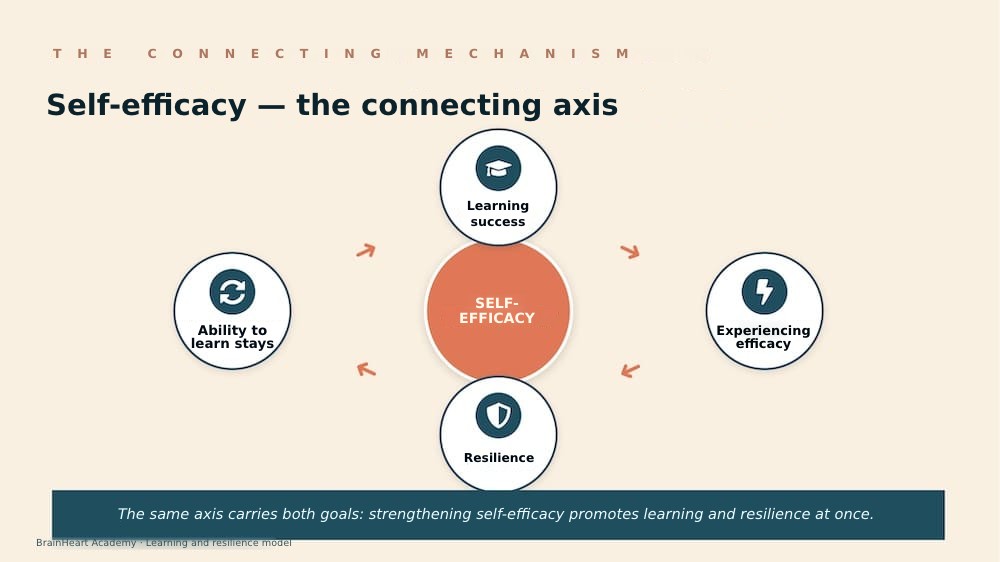
The mechanism linking learning and psychological resilience is self-efficacy. Every learning success is a mastery experience and strengthens the belief ‘I can make a difference’. This belief is also at the heart of resilience — those who experience themselves as effective do not give up in the face of setbacks. And resilience, in turn, protects the ability to learn under pressure. This creates an upward spiral in which learning and resilience support each other. This is precisely why it is a training programme to become a learning and resilience coach: the two are inextricably linked within the same process.
Frequently Asked Questions
My child knows the material at home but fails the exam. What’s behind this? Most likely a nervous system that tips into stress mode under exam pressure — just like Mia’s. The knowledge is there, but access to it is blocked under tension. What helps here is not more practice, but work on regulating anxiety and calming the body.
My child says they are ‘too stupid’. Is that true? Most likely not. Statements like this are an expression of a damaged self-image following repeated failures — not a realistic assessment of their ability. It is precisely this self-image that is usually the real issue.
Are learning blocks a sign of a lack of intelligence? As a rule, no. The vast majority of learning blocks are problems of state, relationship or self-esteem — not problems of intelligence. A child can be highly gifted and still be blocked if their nervous system is in a state of alarm.
When should you seek help? If learning is placing a lasting strain on your relationship with your child, if pressure and tears are part of everyday life, or if a child begins to devalue themselves — then professional support is advisable before this negative self-image becomes entrenched.
What is the difference between learning coaching and private tuition? Private tuition starts with schoolwork and fills gaps in knowledge. Learning coaching starts with the child’s state — their nervous system, emotions, relationships and self-image. Private tuition asks, ‘What does the child need to learn?’, whilst learning coaching asks, ‘What is preventing the child from learning?’ Often, the two complement each other; but if the actual block lies in the child’s state, private tuition on its own will come to nothing.
As a parent, is there anything I can do myself, or is professional help always needed? Parents can do a great deal themselves — particularly adopting an observant attitude, separating the relationship from performance, and creating a sense of achievement. However, in the case of entrenched patterns such as severe exam anxiety or deep-seated resignation, professional support is helpful and often produces results more quickly.
Do learning blocks disappear on their own? Some do — temporary stresses often resolve along with the situation. Entrenched blocks, particularly those involving a damaged self-image, rarely resolve on their own. The longer a child carries the experience of ‘I can’t do this’ with them, the more deeply it becomes anchored. Looking closely early on is worth it.
Read on and explore further
This guide provides an overview. If you would like to explore individual aspects in greater depth, you will find the relevant articles here (coming soon):
- The basics: Learning begins in the nervous system — why safety, the body and memory form the foundation
- The method: The BrainHeart Model: Six phases that make learning possible again
- The psychological side: Resilience and self-efficacy: How inner strength supports learning
- For parents: Supporting learning without pressure
- For professionals: What a modern learning coach really needs to be able to do
Learning support that starts with the individual
In the BrainHeart Learning and Resilience Model, every support process begins not with the subject matter, but with the child’s state. On the training course to become a learning and resilience coach, you will learn to understand learning blocks in a nuanced way — and to open up the way back to the ability to learn for children.
Find out more about the training programme to become a learning and resilience coach
The cases described have been anonymised, with names and details altered. They serve as examples of patterns that I have encountered time and again in over twenty years of practice.
Dott.ssa. Mag. Dipl. Päd. Ernestina Mazza — founder and educational director of the BrainHeart Academy and of akademie bios®.